

Army National Guard veteran Dallas Knight
Content warning: This article includes content about mental health struggles that some readers may find distressing. Please read at your own discretion.
It was a moment that 20 years later would change her life.
As 19-year-old Dallas Knight waited to board the plane on her journey to the war in Iraq, her best friend, who had come to see her off, gave her a final hug before slipping a purple and teal suede-covered journal into her hands.
“‘What’s this?’ I asked her. And my friend said, ‘It’s so you write what’s going on, or write whatever,”’ Knight recalled.
Knight comes from a multigenerational combat veteran family, and her mom was the one who first suggested she join the military. Knight had just graduated high school, had no money for college and, yet, harbored a dream of becoming a Drug Enforcement Administration agent. For that, she needed a degree and real-world experience. An Army recruiter suggested she become a military police officer.
“I decided this was going to be a straight shot ticket to my dream job,” she said. “I figured the Army could help me pay for college and provide the real-world experiences I needed. What I didn’t realize is how real those life experiences would end up being.”

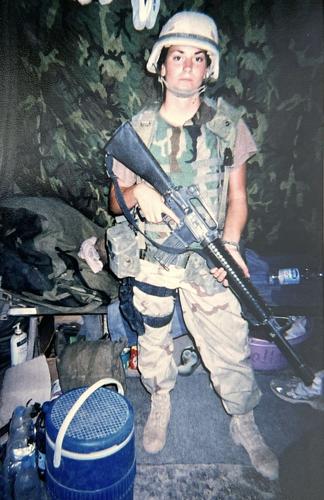
Iraq, circa 2002
She was slotted for basic training in January 2002. Until then, she decided to enroll in a semester of college while training with the Nevada Readiness Center one weekend each month. Turning the radio on the morning of Sept. 11, she heard the announcers talking about a building being on fire. She assumed it was the Stratosphere Tower in Las Vegas that had recently experienced several construction fires. It wasn’t until she turned on the TV that she realized she would be going to war.
That’s how, after training at Fort Lewis in Washington, Knight found herself on the tarmac, journal in hand.
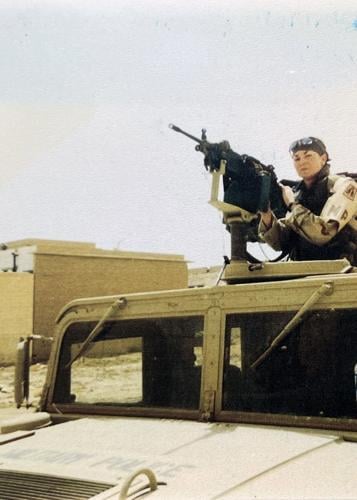
After a brief stay in Kuwait, her unit arrived at the infamous Abu Ghraib prison, where it was responsible for maintaining security over prisoners of war. The unit also ran convoy missions, provided security for supply runs and transport of prisoners.
“There were absolutely scary moments,” she said. “But you don’t have time to process emotion in those situations. You just react in the way you were trained.”
Her unit of 120 included 12 women, the majority of whom worked in operations at the base headquarters. Only a few were military police officers.
“It was rough. Take out the operations people and you have about 85 of us left who were responsible for prison security. We were up 32 hours at a time. For an entire month we were mortared every night at 10 p.m.,” she said. “We just hoped their aim was not great. Luckily, we did not lose any of our people, but some units assigned to us did lose a couple of military intelligence people and we did have injuries. Our equipment wasn’t the best, either. We didn’t receive hard-plated vests until three to four months in, so, honestly, it was a miracle we made it out of there alive.”
Nine months later and stateside, Knight went on to complete her four years in the Army, enrolled in college and then accepted a full-time job as an intelligence analyst for the Army National Guard, working for the state of Nevada under Army orders.
“My dream of becoming a DEA agent had waned. I was tired of getting shot at, so becoming an intel analyst was a nice transition for me. I could work in a cubicle but still support the mission.”
When her year was up, she remained an intel analyst in the same position, but for the Las Vegas Metropolitan Police Department, where she provided tactical strategic intelligence support to multijurisdictional narcotics and violent-crime transactions. Working within the Nevada High Intensity Drug Trafficking Area under the DEA for the next 10 years, Knight pursued and disrupted intricate narcotics operations, successfully dismantling several criminal syndicates.

Knight onboard an Army convoy during her tour in Iraq
Knight made the jump to her first corporate job at a major enterprise software company in 2014 and moved to Billings.
“At first, I thought I had made a mistake taking the job,” she said. “My previous positions all involved working in very disciplined organizational environments. Corporate America was a culture shock to me. Fortunately, I had a lot of great mentors who helped me with the transition, one of whom was a Vietnam veteran.
“We oftentimes don’t think the skills we use in the military translate to corporate, and that’s where this particular veteran helped me,” Knight said. “He rephrased the things I knew I was good at and put those skills into civilian terms. While I thought I was unqualified and not worthy of the job, he helped me see that being able to solve problems, communicate and operate in high-stress environments translates very well. It’s just not how the military spells it out on our resumes.”
Knight shared with him that she had kept a journal of her time in Iraq and he encouraged her to publish it.
“He said this is the story of a 19-year-old girl deployed in a combat zone, and public opinion at the time is that women didn’t do that,” she said. “And honestly, when I came home from my deployment, I was pretty messed up but didn’t seek help. My peers who had declared PTSD had their clearance taken away, but I figured I needed the clearance to continue on with my career. That rule has changed since.”
So, Knight said, she “stuffed it all down and got to work. I was always professionally put together but, personally, made a lot of bad choices, experienced bad relationships. On the outside, I looked like I was good, but I was very depressed and anxious and suicidal. My two sons were my motivation to find my way out of that dark hole,” she said. “I made some changes around my diet and started seeing a therapist.”
Her therapist encouraged her to address her time in the military, something she had never done. So one day, she took out her journal, which was written in pink and purple ink.
It took her six months to get through the 89 original entries. In fact, after reading the first line of one of the entries, she put the journal back down for weeks.
“I didn’t want to relive that night over there,” she said. “My therapist ended up reading it to me and I bawled my eyes out the entire time. I still get emotional about it.”
Knight admits she experienced sexual trauma while in Iraq.
As she read the journal, she added footnotes to each entry, including the thoughts she felt in the moment as she reread the entries. Sometimes, she would elaborate on things, or add more context to express how she felt reading the journals 20 years later.
“I was at the prison and around prisoners,” she said. “When you are in such horrible conditions and you see the lows, the darks and the bads, your standards change and you say, ‘Well, it’s not that bad. I’ve eaten worse, slept less, been treated worse.’ And then you find yourself getting into unhealthy relationships. As a woman I tolerated a lot more than I should have, mainly because I always thought I had been in worse situations.”
Knight reached back out to the Vietnam vet who had mentored her years before and thanked him for putting the idea of a book in her mind. He was actually running a publishing company at the time and, after reading her updated journal, said he would publish it.

Dallas Knight, today
“Shattered Reflections: A Female Soldier’s Unveiled Truth” (2023) is an unfiltered 238-page autobiographical account based on Knight’s raw journal entries.
“I’m constantly asked who the target audience is for this book,” Knight said. “I feel obligated to explain to them that 80% to 90% of the book is what I wrote at 19. I was just a teenage girl writing my thoughts and experiences down in a journal. I’ve received many messages from other vets, female and male, who thank me for giving them a different perspective of war, from wives of soldiers who have said it allowed them to understand things from their husband’s perspective, first responders have read and align with it. It resonates with a lot of people. It’s a book more about the situations we feel alone in.”
The book changed her life.
“It gave me the healing that I am continually building on. What happened immediately was the feeling of validation,” Knight said. “I suddenly understood there must be so many other women out there who feel these things, too.”
Based on the response to the book, and a month after its publication, Knight launched the “(Not So) Average Jane” podcast, which includes interviews with other female combat veterans sharing their own war experiences as they traverse their healing journey.
Eight months after that, in October 2024, Knight founded Operation Juliet, a nonprofit dedicated to empowering female vets through holistic healing, community connection and leadership development. The research-backed platform is recognized for its impact in mental wellness, trauma recovery and reintegration. While still maintaining her full-time corporate job, Knight leads all facets of the organization. Her goal is to expand the organization to chapters nationwide.
And that purple and teal journal? It’s still one of Knight’s most treasured possessions.
As for Dana Johnson, her friend who slipped the journal into her hands that day on the tarmac?
Knight dedicated the book to her.
“If it weren’t for you,
I wouldn’t have had a journal to record my thoughts in.
Thank you for the gift, friend.”