
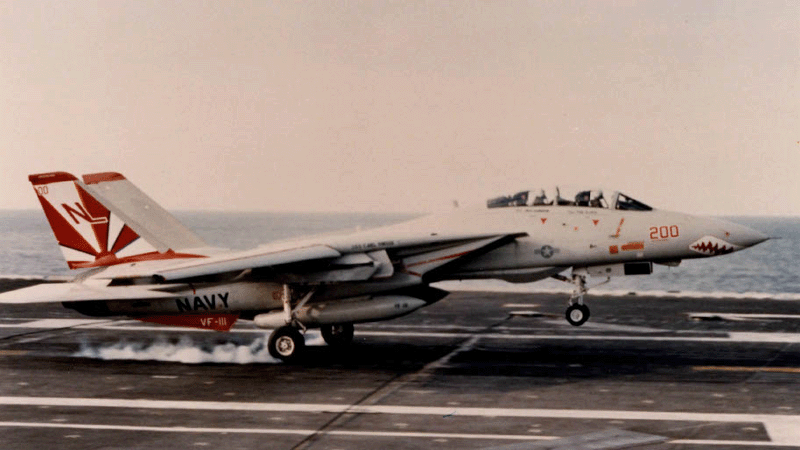
Grumman F-14A Tomcat on the tarmac
Mike Higgins calls it the best seat in the house.
“House” meaning in the air or taking off from a warship at 3Gs in the middle of the ocean, and “seat” meaning the cockpit of a fighter plane.
A naval aviator, who spent 21 years flying Tomcats and Hornets with the best of the best, recalled the moments before taking off from the deck of a ship.
“You go the length of the ship from 0 to 185 miles in 175 feet and it pushes you back in your seat. It’s really fun,” said the Helena native. “You’re kind of just along for the ride, you just sit there and get shot off the ship. Once you’re off, you have to start flying.”
And then there’s the landing.
“It’s the hardest thing,” he said. “The Tomcat had a lot of great characteristics about it, but landing on the boat was not one of them. What you’re doing is really difficult. You have to have the airplane on the glide slope, lined up on the center line. You have to keep the aircraft at the appropriate speed, all the while the ship is moving through the water, the waves tossing it about, and the wind is blowing, so you’re always compensating for the line and then you just fly right in on full power until, ‘bang!,’ you hit the deck and catch the wire. If it doesn’t catch, you’re still at full power, so you just take off and try it again.”
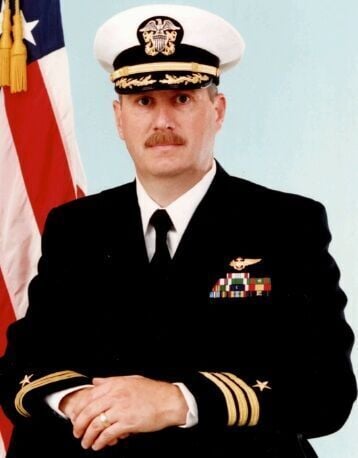
Mike Higgins, naval aviator
Higgins laughed when he called the Tomcat a “big ol’ hunker, all 54,000 pounds of it. And the full stop on the ship is an aggressive one.
“When you’re stopping that quickly after going full power, the moisture in your eyes all goes to the front of your eyes, so it looks like you’re underwater for a second. It’s definitely a lot of banging around.”
Flying at 6 ½ and 7 ½ Gs for all those years, “you definitely pay for it later,” he said, meaning his five surgeries on his neck and back.
But he wouldn’t trade it for a second.
Of all his time in the air, one of his favorite memories is at night flying over the Sea of Japan.
“It was absolutely crystal clear out,” he said. “It felt like you could reach out and touch the stars, it was that clear. There were Japanese fishing boats below on the water, looking for squid. They put these lights under the water, and the light from the sky and the light from the water just blended together and you couldn’t tell the sea from the sky. It was that pretty.”
In between the 21 years of takeoffs and landings, Higgins served five deployments on the USS Carl Vinson; taught fighter pilots how to fly the Tomcat aircraft at VF-124; was a student, as a test pilot flying the brand new Hornet at Top Gun — the U.S. Navy Fighter School at Naval Station Miramar in San Diego; was part of the two Top Gun squadrons selected to be the fighter pilots that appeared in the 1986 film “Top Gun”; flew in multiple dogfights with enemy aircraft; served as part of an advance strike training force teaching “guys how to be war fighters”; and served a command tour as Chief of Combat Plans (DOJ) for the Seventh Air Force (Osan Republic of Korea), where he trained troops on how to launch Tomahawk Land Attack Missiles (“just like the ones you see on TV now”).
While he was fortunate enough to not have to eject and parachute from his plane during his service, Higgins said he lost a lot of friends along the way.
“It’s in our minds that we are all invincible, and that’s why we got in the plane every day and did what we did,” he said. “I think some people have a stereotype that fighter pilots are arrogant, but you have to sit back and think, maybe there is a reason for that confidence? If you’re a bomber guy and you’re going to do something in war, you go do it. As a fighter pilot, though, our job was to defend the bomber guy, suppress the enemy air defense.
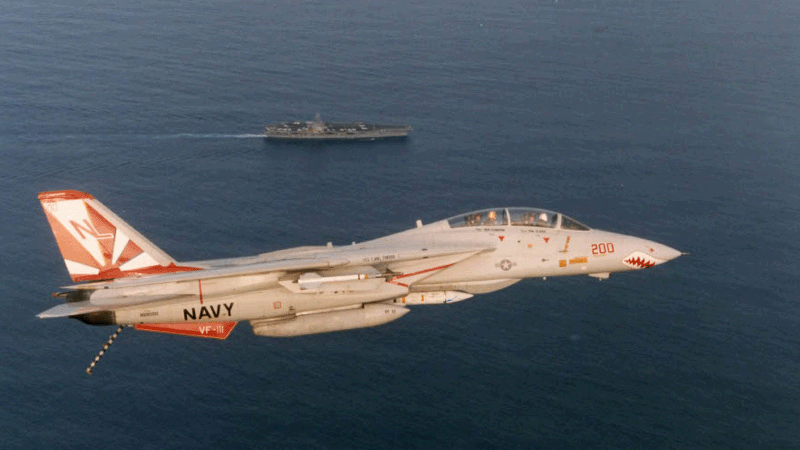
Grumman F-14A Tomcat flying high
“In training, you are taught to think you are the best, because if you aren’t, you will fail,” he said. “The system reinforces that everybody is the best. You have to go into the fight believing you are the better pilot, the better tactician and that you’re going to beat the enemy. You have to have that edge going in or you will automatically fail. So yes, that does build a stereotype of an egotistical fighter, but there is a purpose to it. You go fly your mission, knowing that you can win.”
When it comes to fighting in the air at a speed of about 460 mph, Higgins said it’s one of the most demanding feats.
“In order to pull 7 ½ Gs, you are pulling between 50 to 70 pounds on the stick with one hand and twisting and turning the entire time, looking for the enemy aircraft. All the while, you have to anticipate where someone is and where you think he will be and put yourself in that appropriate position. If the enemy doesn’t do what you think he’s going to do, you have to keep working in what I call three-dimensional movement, thinking where he will be next, where do I need to be, without him shooting you down. And then there’s the fourth dimension, which is time. How much time is it going to take to get into that anticipated position?”
Higgins said it’s not uncommon at all to come back to the ship having lost 10 pounds of water weight, completely soaked through, mentally and physically.
So back to “Top Gun.” Did he make the cut?
By the time filming had started, Higgins was selected to be an operational test pilot with VX-4 at NAS Point Mugu, as part of the Test and Evaluation Squadron.
“It was like two wonderful things happening to me at the same time. But I knew every pilot that appeared in the movie,” he said. “They were either part of my fighter squadron or the other one that had been selected.”
Two weeks after he submitted his retirement papers at the age of 42, Higgins was hired by United Airlines, where he worked for the next 22 years.

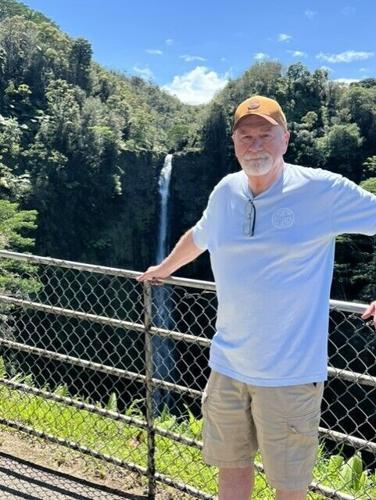
Mike Higgins, today
“Flying for the airlines was nothing but relaxing,” Higgins said. “Fighter planes are built as minimally as they can be. You can’t put too much stuff on them or they won’t be able to maneuver in the air as you need them to do. So, every time we’d come back to the ship, there would always be two or three things that had broken or needed to be fixed. We were so used to dealing with emergencies in the air, and that’s one reason why airlines like to hire fighter pilots. But commercial airlines are so unbelievably safe and reliable, you could fly for six months and never have a single little thing go wrong. But up in a fighter plane, it was daily.”
After retiring from United, Higgins served nearly three years as an air ambulance pilot in northeastern Montana and two years as an air fighter for the U.S. Forest Service and the Department of the Interior.
“It felt good to be back in the air helping people,” he said. “There’s so much camaraderie in the service, and it felt good serving my country, doing my part to defend the Constitution, and doing air ambulance work, made me feel like I was serving again.”
When flying commercial as a passenger these days, Higgins likes to nab a window seat. Why?
“Because as a fighter pilot, that’s where the auxiliary controls are in my mind. But it’s still not comfortable for me,” he said. “I’d rather be in front, flying.”
It’s not inconceivable that Higgins could find himself in the cockpit again. The “Maverick Act” to authorize the Navy to transfer three retired F-14D Super Tomcats to the U.S. Space and Rocket Center in Huntsville, Alabama, is moving through Congress and could allow private groups to restore one of the Tomcats for airshows. If that happens, they just might need a pilot.
“I’m ready to go,” Higgins said.
Sponsored by AARP, Stories of Honor features profiles of veterans living across Montana. For more information, please visit aarp.org/storiesofhonor.
This content was produced by Brand Ave. Studios. The news and editorial departments had no role in its creation or display. Brand Ave. Studios connects advertisers with a targeted audience through compelling content programs, from concept to production and distribution. For more information contact sales@brandavestudios.com.
In this Series
Stories of Honor
-
Updated
Stories of Honor: Mike Higgins
-
Updated
AARP Stories of Honor: Dallas Knight
-
Updated
Stories of Honor: Greg Bahny
- 20 updates