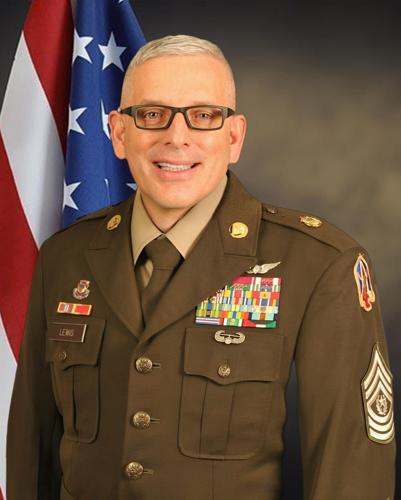


David Lewis’ father volunteered for the Army and was deployed to Vietnam. His grandfather served as a photographer in the Army Air Corps during WWII and served for 20 years before retiring.
From both, David Lewis said, details were sparse, if not nonexistent, while growing up in Great Falls, Montana. His dad, who owned a gunsmith shop, rarely spoke about his days in uniform. About the only thing Lewis knew about his dad’s service was that he was a Purple Heart recipient. As for his grandfather’s experience, it wasn’t until after he passed away that Lewis ended up in possession of a personnel folder with some of the WWII photos his grandpa had taken and discovered by chance that his grandpa’s roommate was entertainer Danny Kaye.
“He had a lot of photos of Gen. Douglas MacArthur, and all the entertainers on the USO camp show at the time, including the Andrews Sisters. It was pretty interesting stuff and I wish I knew more about that time from him,” Lewis said.
As for himself, a year out of high school Lewis said he “wasn’t doing much in terms of work. I was at a point where I needed someone to tell me what to do, where to go. I needed structure.”
That was in 1989. Today at 57, Lewis proudly talks about his days as a “lifer” — three years active Army, 11 years traditional National Guard and 21 years as full-time National Guard. Throughout the course of his nearly 35 years of service, Lewis was deployed to Korea (1989-90), Iraq (Operation Desert Storm, 1990-91) and Kuwait (Operation Enduring Freedom, 2013-14); and held four Military Occupational Specialties and 10 leadership positions. Along the way, he earned his bachelor of science degree in liberal studies from Purdue University Global.
Lewis’ extensive military education consists of Primary Leadership Development Course, Basic Non-Commissioned Officer’s Course, Advanced Non-Commissioned Officer’s Course, Mechanized Infantryman Course, Human Resources Specialist Course, CH-47 Helicopter Repairer Course, Senior Enlisted Joint Professional Military Education Course, and the United States Army Sergeants Major Academy Class 45 (DL).
“When you have this many years of service, people don’t realize the amount of time you have to spend going to school to advance through the ranks,” Lewis said.
He chuckled as he described his initial training as a chemical operations specialist.
“Mechanized smoke was part of the chemical corps (4th Chemical Company). It doesn’t exist anymore. In fact, a smoke tank like the one we trained on and drove all over the place in Iraq is now in a museum at Fort Hood (Killeen, Texas),” he said. “You know you’re old when the stuff you used to drive is in a museum.”

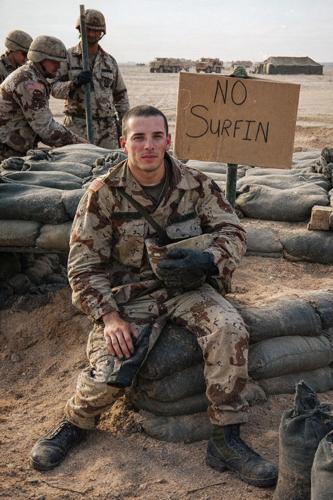
But during Operation Desert Storm, the tanks were used to blow smoke over a battlefield so troops could fight without being easily seen.
“We were the only mechanized smoke company blowing smoke for the tanks and the Bradleys during the Gulf War,” Lewis said.
That assignment also meant that as an E3 private he spent endless hours and days driving the smoke tank everywhere from the inland port at Riyadh, Saudi Arabia, to the Iraqi border and all points between, as well as along the Highway of Death, the six-lane highway connecting Kuwait and Iraq.
“It was a crazy time,” he said. “There were a lot of dead bodies, blown-up tanks along the way, lots of things you’ll never forget. Iraqi soldiers, often starving and scared, would come up to us to surrender, especially after the bombing raids. We had to process them and they didn’t speak any English. It was like POW processing. In my entire military career, that deployment was probably the roughest conditions to spend time and live in.”
Lewis said his squad went three months without showers, with no formal latrines and no hot food (only prepackaged meals ready to eat). Nearing the end of the eight-month deployment, he and his fellow troops spent two months holed up in the King Fahd Airport parking garage in Saudi Arabia waiting for transport back home.
His deployment to Kuwait in 2013 was the exact opposite experience. Returning with the 189th General Support Aviation Battalion (Helena), he had access to air-conditioned buildings, daily hot showers and “great food,” as he said.

“I think the first takeaway for anyone in the military is that no career in uniform is ever carried by the soldier himself,” Lewis said. “My family, my wife, my two kids had to deal with my long days, the training events, the missed moments, anniversaries. I had the privilege to serve in a wide range of positions which were all amazing and I made it to the top of the National Guard. Those are milestones for me. My path was not a straight line — chemical operations specialist to combat veteran, guard soldier, command sergeant major. These are just a few of the positions I held.”
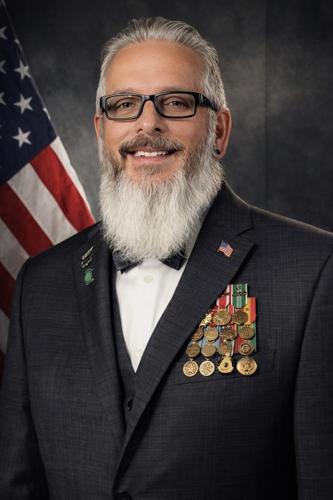
Lewis retired from the National Guard in 2024 and took a job as a safety investigator for the Federal Motor Carrier Safety Administration. He also continues to fight for retired veterans as president of the Enlisted Association of the National Guard of Montana, a nonprofit that is part of the national organization supporting enlisted National Guard members. The group works to protect benefits and advocates for both the Army and Air National Guard members.
“From the years I spent working in human resources at the National Guard, while I can say it’s not the glamorous part of the military, it’s important because it ensures these soldiers receive their life insurance and benefits. EANGMT lets me still fight for these soldiers after their retirement,” he said. “It gives me the same mission the Army gave me in taking care of people.”
For more information on AARP’s Stories of Honor, please visit aarp.org/storiesofhonor.