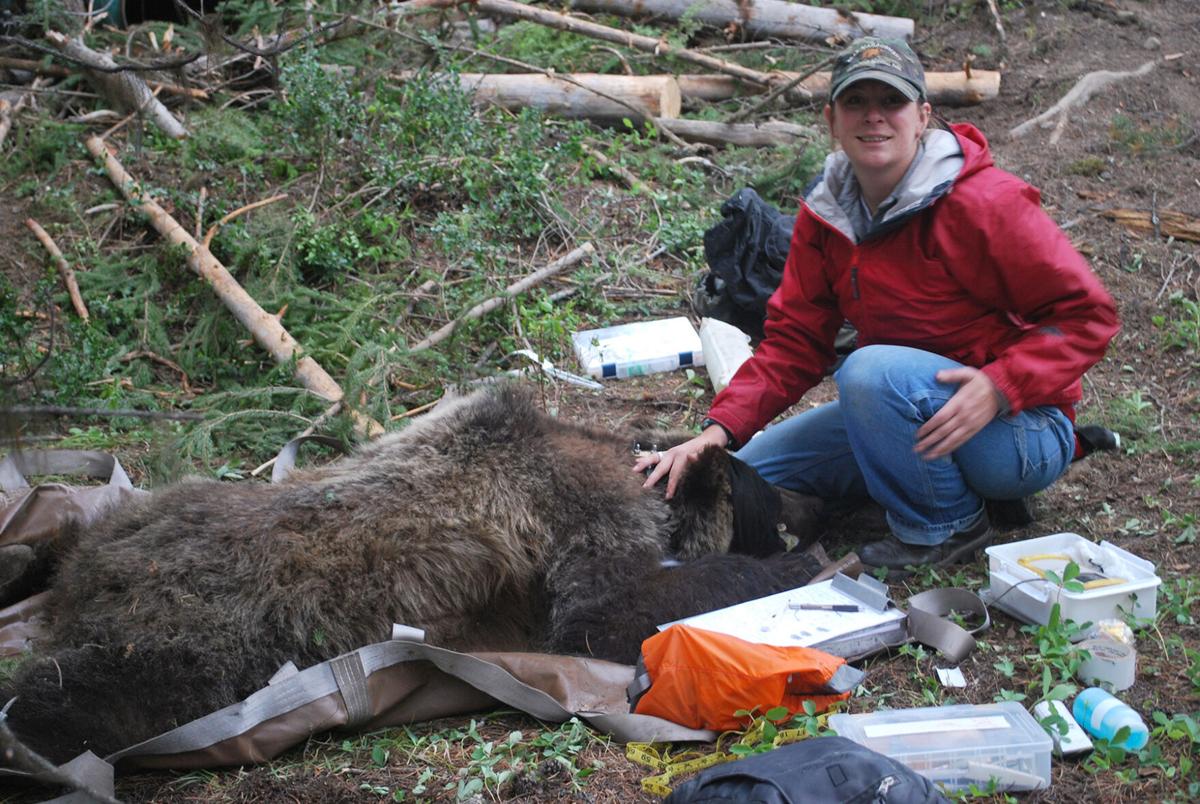
Lori Roberts has been a member of the Northern Continental Divide Ecosystem (NCDE) Grizzly Bear Trend Monitoring project for 17 years. The NCDE team is tasked with monitoring the trend and survival of the largest population in the lower 48 states. To monitor the population, the team deploys radio collars on female grizzly bears and monitors their survival and reproduction and the survival of their offspring.
Recently, Roberts published a scientific paper on detecting parturition in the den using activity data stored on the radio collar. Parturition is the action or process of giving birth to offspring. The project was a collaboration among several state and federal wildlife agencies.
It involved using a new technique to detect the occurrence and timing of parturition events. Using data gathered through radio collars, biologists measured the bears’ activities in their dens. The collars recorded the bears’ movements for 10-minute increments about 150 times a day.
Because grizzly bears give birth during hibernation, observation of litters is generally not feasible until females exit dens, and then detection of litters by flight surveys can be compromised by poor observability and weather conditions.
“During hibernation, females lie relatively still. After a bear gives birth, she sits upright and begins licking,” Roberts said. “The radio collars captured these changes in behavior. The data showed that parturient females exhibit a visually distinct, short-duration upsurge in daily activity that usually lasted between one and four days, and occasionally up to eight days. For bears that were later observed without cubs, the radio collars did not record an upsurge in movement.”
The study was conducted using data obtained from grizzly bear populations in four study areas of western North America: Greater Yellowstone Ecosystem (GYE); NCDE in Montana; Selkirk and Cabinet-Yaak Ecosystems (SCYE) in Idaho, Montana and British Columbia; and Gates of the Arctic National Park and Preserve (GAAR) in north-central Alaska.
“We will continue to gather parturition information and just keep track of any significant changes in birth and/or cub loss in the den or immediately after,” Roberts said.
This content is sourced from
Montana Fish Wildlife parks
. It reflects the author's views and has not been edited by our newsroom. It may have been generated using AI assistance.