


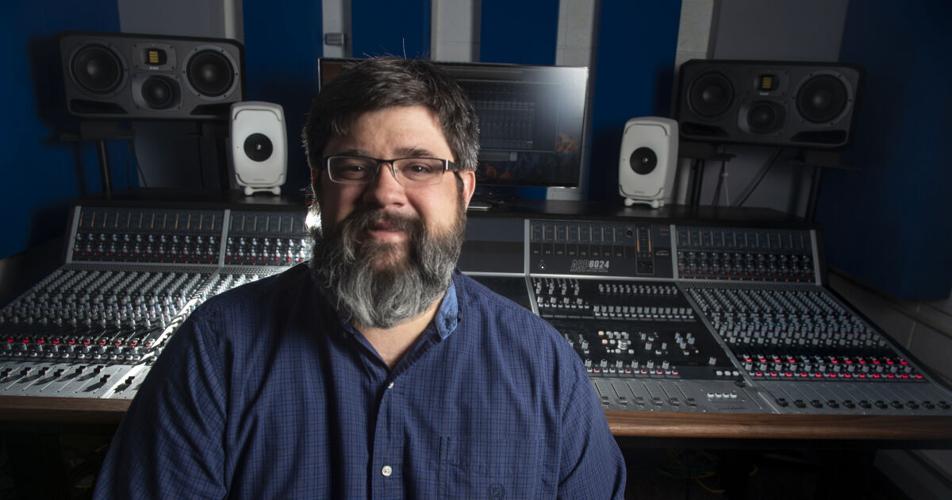
BOZEMAN — One may find Jason Bolte below ground, sampling the acoustics of the Lewis and Clark Caverns near Whitehall. Or perhaps on stage in Reynolds Recital Hall at Montana State University, plucking cactus spines like the strings of an instrument. Or, what he says is the most rewarding of all, in the classroom as director of MSU’s School of Music in the College of Arts and Architecture.
Bolte has spent 16 years at MSU, serving as director for six, which he will cover in the presentation “A Fascination with Sound” on Tuesday, Nov. 3, as part of MSU’s annual Provost’s Distinguished Lecturer Series. The event will begin at 7 p.m. in Howard Hall’s Reynolds Recital Hall and include a reception afterward. All events in the lecture series are free and open to the public.
People are also reading…
The lecture will highlight Bolte’s path to music technology and include performances of his original compositions. Bolte’s work manipulates natural and synthesized sounds to capture his personal experiences. Several years ago, he recorded his daughter playing with a toy glockenspiel and a Happy Apple toy filled with bells for a collection of compositions titled “Child’s Play,” which explores the feeling of watching his daughter grow up.
“I know what it means to me, but I don't know how a piece of music is going to be interpreted by a listener, and I find that to be fascinating,” he said. “It could trigger memories of things that I never would have even thought of because they're not my experiences.”
Many of Bolte’s compositions allow listeners to immerse themselves in a different world. He has previously collaborated with MSU faculty to create three public ArtScience installations at the university and across Montana, combining the two fields to help viewers experience science firsthand.
In 2017, Bolte composed a 30-minute loop capturing the sonic environment of a cave, recording water dripping from a bathtub spout, rocks rubbing together and acoustics in the Lewis and Clark Caverns. The ArtScience CAVE exhibit brought together multiple artists, a neuroscientist and computer scientists to create an installation that merged 35,000-year-old art with explorations in neuroscience. Participants put on a headset that monitored their brainwaves and, through neurofeedback transmitted to a small computer, generated pulsing light and sound that was projected back into the room. Some participants opted for their data to be used for MSU research on how the brain responds to different stimuli in group settings and individually.
Bolte, who grew up in Ferdinand, Indiana, said he was first drawn to science as a child and dreamed of becoming an astronaut. However, he came by music more naturally. Nearly every weekend, his father would perform at weddings and local taverns. His father, a singer, guitarist and trumpeter, rehearsed with his bands in the family’s basement — Bolte said he can still recall the plasticky smell of late 1970s amplifiers.
Bolte was a trumpeter in high school before attending Ball State University for degrees in music engineering technology and music composition, later earning a doctorate in composition from the University of Missouri, Kansas City, Conservatory. Each of his five siblings also played an instrument or sang. Bolte’s own family is much the same, with his wife and two daughters all involved in music.
“Music is definitely an important part of my family, but I think it's also an important part of what makes each of us who we are, what makes us human,” Bolte said.
An emphasis on the value of music education has ushered in a surge of growth in the School of Music under Bolte’s tenure as director. The school developed a master’s degree in music education, which primarily serves licensed music teachers online; grown the number of students participating in ensembles, such as the Spirit of the West marching band with more than 200 members; and expanded its classrooms and music technology studios to Gianforte Hall, a new building for students in computing-related fields, including those in the Gianforte School of Computing.
Gianforte Hall is equipped with recording studios and lab space for music, film and photography students. The studios’ high-end sound systems, professional software and acoustic design are what students can expect to work with in the music technology and film production industries, Bolte said.
The impact of the new building, and that of the School of Music, is felt across campus, he added. More than 70% of the students participating in the school’s 20-plus ensembles are majoring in disciplines other than music, and many are recipients of music scholarships.
“The School of Music reaches students all across campus, not just our majors and our minors, but also students who have a love of music and want to express it,” Bolte said.


