


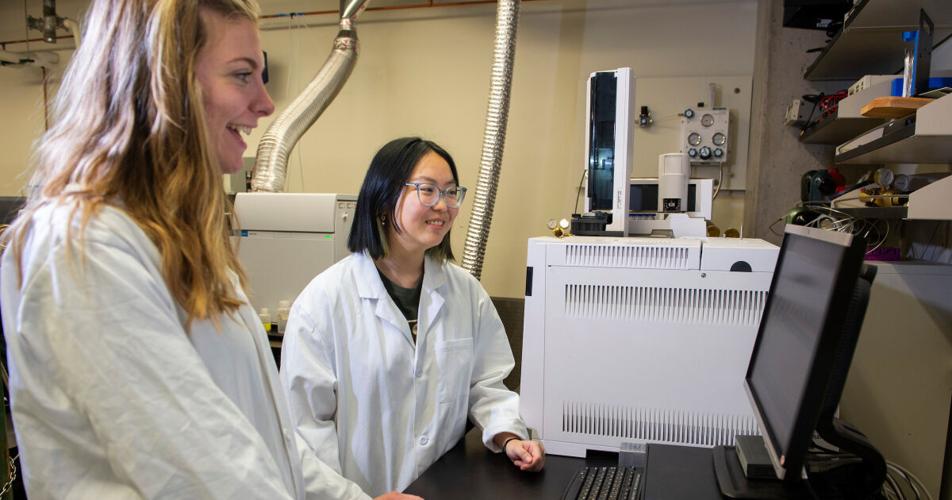
BOZEMAN – At Montana State University’s mass spectrometry core research facility, users can determine with high confidence the chemical composition of liquids, solids or gases – a capability essential to any top-level chemistry program at an academic institution, according to the facility’s director.
“You can compare us with any other university in the country and see that we’re unusually well outfitted with equipment,” said Brian Bothner, a professor in MSU’s Department of Chemistry and Biochemistry and Distinguished Professor in the College of Letters and Science who has directed the Montana State Mass Spectrometry facility since 2008. “That’s allowed us to not only work with people in five colleges at MSU, but we’re also a regional resource for the technique.”
People are also reading…
Mass spectrometry can be used to answer a breadth of questions in the biochemical and chemical realms. To name a few, health professionals use it to detect inflammatory markers, toxicologists use it to measure the amounts of drugs or heavy metals in blood or tissue, and industry and regulatory agencies use it routinely to ensure that virtually any consumer good is safe.
At MSU, researchers from nearly every discipline make use of the facility.
“Anything that is studied on this campus, including the way we interact with people or art or anything, in the end is chemistry,” said facility manager Don Smith.
The facility houses numerous, specialized mass spectrometry instruments, all of which work a little differently to determine the masses of ionized molecules. An inherent property of each molecule is how much it weighs, and the molecule can be fragmented in the instrument to reveal the combination of its elements, Smith explained.
The facility is one of 12 core research facilities at MSU dedicated to advancing research, training students and contributing to MSU’s outreach mission. Each MSU core facility comprises specialists and resources dedicated to assisting faculty, students and outside users with their projects.
“We have the unique opportunity to serve both veteran users as well as new users, which is really my love – introducing people to mass spectrometry and its power,” Smith said.
The facility’s staff is currently helping researchers from Fort Peck Community College analyze more than 1,000 plant, soil and bison fecal samples for a study of the relationship between what bison on the reservation are eating and the contents of different metals in their bodies.
“To me, this is a very Montana project that meets our goal as a land-grant institution,” Smith said. “They are reintroducing bison into their natural habitat and leveraging what we can do to help understand what the bison should be eating and what they should not eat.”
With its new gas chromatography mass spectrometer, or GC-MS, the facility also is assisting researchers in the Department of Animal and Range Sciences with another kind of animal research. Through the analysis of rumen samples taken from a compartment in the stomachs of cattle, the researchers are gaining insight into bovine digestion.
Bothner said that unlike mass spectrometry facilities at other institutions, the MSU’s is user driven and focused on training.
“We do great work and we can analytically compete with anybody, but at the same time we’re training students, postdocs and faculty to do mass spectrometry,” he said. “At most places, you just hand off your sample, and they give you data back. That’s not the way we operate at all. We train people to design the experiments, run the instruments and do the data analysis.”
For that reason, Bothner said, students who work in the facility are competitively “leagues ahead” when they leave MSU and seek professional positions.
“That’s the best part of the job – to know we’re putting out well-educated, critically thinking people who don’t just take a report at face value,” Smith said. “I never want to lose the wonder of what we do. It is fascinating.”
In addition to scientists at MSU and the tribal colleges, the facility also assists researchers at MSU’s satellite campuses and analyzes samples for industrial users. Inquiries about the facility’s services can be directed to Don Smith at donald.smith@montana.edu or Brian Bothner at bbothner@montana.edu.
“Core facilities like mass spectrometry multiply the impact of Montana State’s research investments,” said Alison Harmon, MSU’s vice president for research and economic development. “They give faculty and students access to sophisticated capabilities that would be difficult to replicate in individual laboratories while also making that expertise available to researchers and industry partners across Montana and the region.
“Just as importantly, our students gain unique hands-on experience with advanced instrumentation and data analysis that prepares them exceptionally well for careers in research and industry,” Harmon said.


