


BOZEMAN — Janos Zsofka told himself he wouldn’t join law enforcement after leaving the U.S. Marine Corps. It was simply too cliché, he thought.
He said roughly one-third of his scout sniper platoon pursued a career in law enforcement after leaving the Marines, hoping to find a similar sense of purpose. Zsofka tried attending a two-year college and working in construction but found himself missing the sense of camaraderie and duty he gained throughout his six years in the military. He joined the Marines at age 23 as an infantryman and rose to being second-in-command of his 26-member platoon.
Now, nearly three years later and 31, he is a newly hired officer at the Gallatin County Sheriff’s Office and will celebrate completing his in-person training from Gallatin College Montana State University’s Law Enforcement Academy in a ceremony on Friday, Aug. 7. He is one of 14 students in the academy’s inaugural class.
People are also reading…
“On the job, you're typically dealing with people on their worst day,” said Zsofka, who is originally from Derry, New Hampshire, and has lived in Bozeman for one year, working in construction. “You're not always able to help them, but you can at least try. That's the reason why I got into this, having that purpose.”
Gallatin College MSU’s Law Enforcement Academy is only the second law enforcement training school in the state. The first is Helena’s Montana Law Enforcement Academy, which was previously housed at MSU from 1959 to 1976. The academy supports the rising number of entry-level officers in Montana and the subsequent need for training space, said Adam Pankratz, deputy chief of MSU’s police department and program coordinator for the academy. In the last 10 years, Montana has added more than 400 new law enforcement officers, according to the Montana Board of Crime Control. Gallatin College MSU received $320,000 in federal funding this year for the academy’s startup costs.
The academy accepts entry-level officers like Zsofka, who are sponsored by agencies across Montana, as well as civilians who are interested in pursuing law enforcement.
“What makes this graduating class special is their deep dedication to the local communities they will soon protect,” Pankratz said. “Grounded in MSU's core land-grant mission to serve the people of Montana, these students will enter the workforce not just as newly minted officers, but as public servants equipped to meet the evolving needs of our state with integrity, empathy and professionalism.”
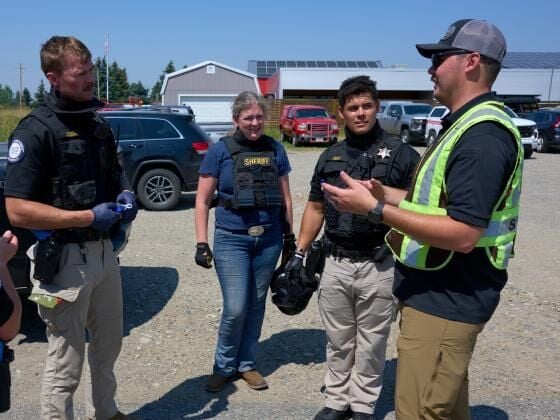
Zsofka and his peers spent 14 weeks this summer studying defense tactics, completing firearms training and simulating scenarios with volunteer actors and with the college’s virtual-reality set. Each lesson drew on a foundation of case law and ethics to ensure students serve their communities well. The curriculum was designed in partnership with local law enforcement agencies that are sponsoring students or planning to hire them in the future. Active officers from multiple agencies instruct each course, which provides students with insight into the function of each agency and scenarios officers encounter regularly, said Michael Van Meter, training division captain of the Gallatin County Sheriff’s Office, who managed Zsofka’s orientation.
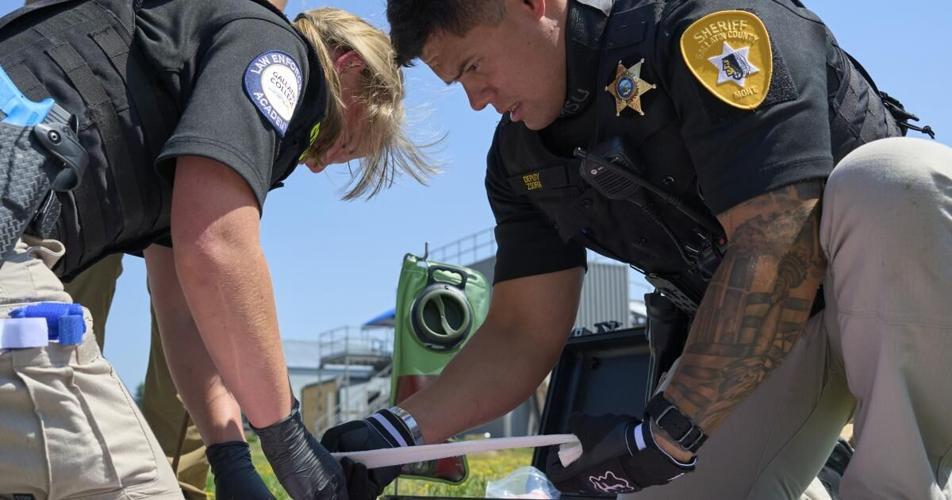
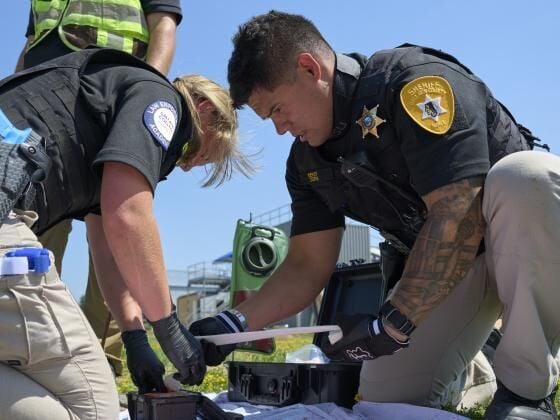
Scenarios spanned domestic disturbances, traffic stops and medical emergencies involving community members and fellow officers. A simulator replicated gunfire as students responded to a mock “officer down” call, stopping the officer’s wound from hemorrhaging and evacuating the officer from the scene. Zsofka said he learned to remain calm under pressure and communicate well with his team to avoid the mistakes that come with tunnel vision and adrenaline.
“Without these realistic, high-stress scenario trainings, we can only speculate how we would respond in real-world situations,” he said. “The scenarios gave us the opportunity to see and feel how we might actually respond and become familiar with stress, teaching us how to manage that stress.”
Zsofka said the academy’s smaller instructor-to-student ratio allowed students to dive into scenarios and case studies at greater depth, as well as receive one-on-one instruction in group settings. He found this to be especially helpful during firearms training at the Gallatin County Sheriff’s Office shooting range, where instructors helped students improve their marksmanship individually.
Van Meter said Zsofka’s work ethic in the range, classroom and defense tactics dojo makes him a capable deputy and will serve him well after the academy’s completion ceremony. During the ceremony, Zsofka will receive the academy’s defensive tactics and firearms awards for his high skill level in those areas, as well as a peer award. His peers nominated him as the person they would most like to be their partner in the field.
“From the beginning, I was impressed with Janos’ humility and work ethic,” Van Meter said. “He’s also quick to volunteer to help and take care of tasks. This is definitely a quality that we look for within the sheriff's office.”
Zsofka will return to the sheriff’s office this month for the next phase of his training, which includes an online course from Gallatin College MSU and working with a training officer in the field for several weeks before his final evaluation. He is considering applying for the Gallatin Valley SWAT team in the future after gaining experience in the field.
“It's weird, but I'm excited to get reevaluated again from my field training officers to see if I’ve actually taken what I’ve learned from here, which I believe I did,” he said. “I feel more confident. It’s also pretty cool that we're the first class of students. We have a little part in history.”


