


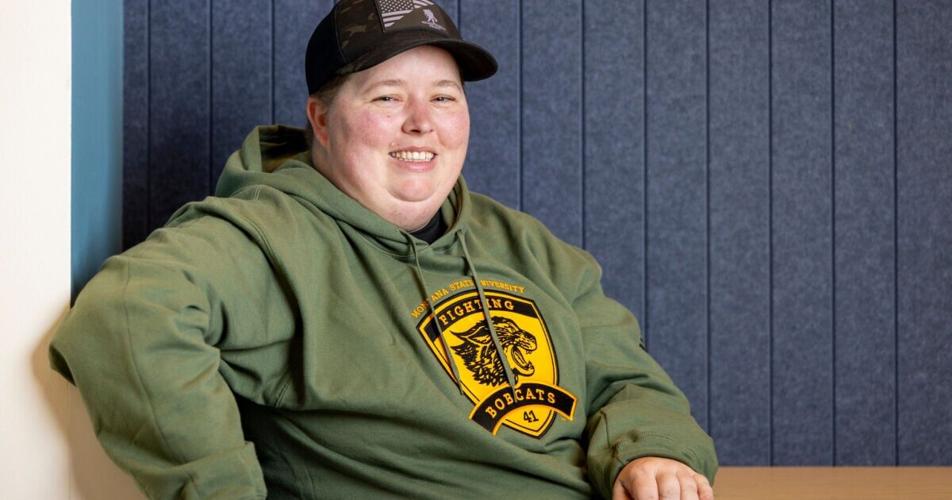
BOZEMAN — Erin Alexander is a veteran of the U.S. Navy, a fact that is written all over her.
Her baseball hat announces in pink thread that she’s a female combat veteran, while her T-shirt displays the core values of Operation Juliet, a nonprofit for female veterans of which she is a board member.
It even extends to her psychology research as a senior in the College of Letters and Science at Montana State University.
“It actually makes research a little bit easier because I have those lived experiences, and I think it allows me to look at things from a different lens,” said Alexander, who joined the Navy after graduating from high school in Cocoa Beach, Florida.
Now, through MSU’s EMBER lab, Alexander studies veterans’ transitions from the military to civilian life and how isolation or shared experiences with other veterans impacts their mental health. EMBER — or the Existential Motivation, Belonging and Experimental Research — lab received a $15,000 grant for this work from the Veteran Transitions Research Lab, which focuses on veterans’ high turnover rates in civilian jobs, said Peter Helm, principal investigator for EMBER and assistant professor of psychology.
People are also reading…
Before the lab begins tracking veterans during their first year out of the military, Alexander gathered initial data from 40 veterans at a statewide conference in Billings and surveyed an additional 209 veterans across the nation. Montana has the third-highest number of veterans per capita in the country, according to the Montana Veteran Affairs Division, and is listed among states with high suicide rates in veteran communities.
Alexander and Helm noticed that veterans’ disconnect from civilians correlated with worse mental health and more difficulty holding down a stable job. Alexander presented the preliminary research at MSU and at a Rocky Mountain Psychology Association conference in Idaho.
She found her own experiences reflected in the veterans she studied. Alexander had spent four years on a naval disaster response team that mitigated fires, floods or toxic gases aboard ships. This entailed many sleepless nights on watch and responding to alarms that roused Alexander from the pillow where she had just laid her head and sent her running. She deployed to the Persian Gulf twice and the Mediterranean Sea once.
After she was discharged, Alexander said she struggled to navigate post-traumatic stress disorder and find her purpose in life, which lit a fire under her to advocate for female veterans’ mental health.
“She's part of this community,” Helm said. “She's actively working in this community. She's not an outsider who's coming in with these ideas. Erin’s connected the lab with all sorts of people and organizations who are passionate about veterans’ well-being, and I don't think this could really happen without her.”
With Helm, Alexander also began a separate study over the summer as part of MSU’s McNair Scholars Program. The program supports underserved students, such as first-generation students or those from low-income backgrounds, with research and mentorship opportunities to provide them with the knowledge and training to successfully pursue graduate school. Alexander is a first-generation student, whose immediate family members don’t have a four-year degree. She earned her first bachelor’s degree in recreational therapy from Florida International University, later moving to Montana for work and then enrolling at MSU when she lost her position in the Montana Department of Agriculture due to budget cuts.
Alexander attended an Operation Juliet retreat in Wyoming to collect data on 20 women from 11 states, four branches of military and three generations of conflict. She is analyzing how community-based programming impacts female veterans’ healing processes and whether it positively connects them with others who have shared life experiences or makes it difficult for them to move on to a new chapter in their lives surrounded by civilians.
This holds importance for Alexander because she was also a recipient of “life-changing” peer support through Warrior Progressive and Alternative Training for Helping Heroes, where she picked up songwriting as a tool for expression. This year, she released “Leaving the Past Behind,” an online album about her time in the military. In it, she explores topics like PTSD and her close relationship with her father, an Army veteran.
For her work at MSU and beyond, Alexander has earned three social impact awards from the university. She also received the Colonel Bert and Deanna Rice Scholarship from the Travis W. Atkins Veteran Support Center in the spring. Financial aid is one of several services, including in-house tutoring, that Alexander uses in the center at MSU, which was named the No. 1 military-friendly university in the nation this year by Militaryfriendly.com.
“I know if I'm struggling with something, there's always someone at MSU who can help me, whether that's something to do with my VA benefits or my education or I just need to talk to someone,” she said. “People have bent over backwards to help me be successful.”
Alexander will graduate from MSU in December with a psychology degree and Leadership Fellows certificate. She is applying to clinical psychology programs in pursuit of a Ph.D., which she will use to become a consultant for veteran nonprofits, a practicing psychologist or a professor in the future.
“This next step is going to challenge me, but I also think it's going to help me achieve things that even a few years ago were beyond my wildest dreams,” she said.


