


BOZEMAN – Montana State University sophomore Murray Stebbins jumps at opportunities to learn and build skills related to quantum computing. Most recently, he participated in the inaugural session of a new cryogenics training boot camp offered in August at QCORE, MSU’s research facility dedicated to the study of quantum computing.
Stebbins, who is majoring in mechanical engineering in MSU’s Norm Asbjornson College of Engineering, was one of 10 students selected for the course from an applicant pool ranging from college freshmen to industry professionals. QCORE, which stands for Quantum Collaborative Research and Education facility, hosted the training in collaboration with Gallatin College MSU, Honeywell Aerospace and Montana Instruments, a Bozeman-based company specializing in cryogenics technology.
People are also reading…
The camp was developed in response to a growing need for professionals experienced in operating, maintaining and troubleshooting the ultra-low temperature, low-noise environments in which quantum technologies operate.
“The quantum industry is dynamic, and programs like this boot camp are unique opportunities to support the emerging workforce needs,” said QCORE director Jayne Morrow. “It’s been amazing watching the close collaboration of this talented team as it came together to support our students and Montana’s industry.”
Seven students from MSU, two from Gallatin College MSU and one from the University of Wyoming earned digital badges for the specialized skills they acquired during the week of intensive classroom instruction, laboratory demonstrations and hands-on learning.
Participant Travis Gamble, a second-year student in Gallatin College MSU’s Photonics and Laser Technology program and a graduate of its IT Network Technology and IT Cybersecurity and Information Assurance programs, said he is already excited about putting to use the “incredible knowledge” he gained at the camp when he joins the local photonics workforce after completing his studies next spring.
“I want to help the local area thrive,” he said.
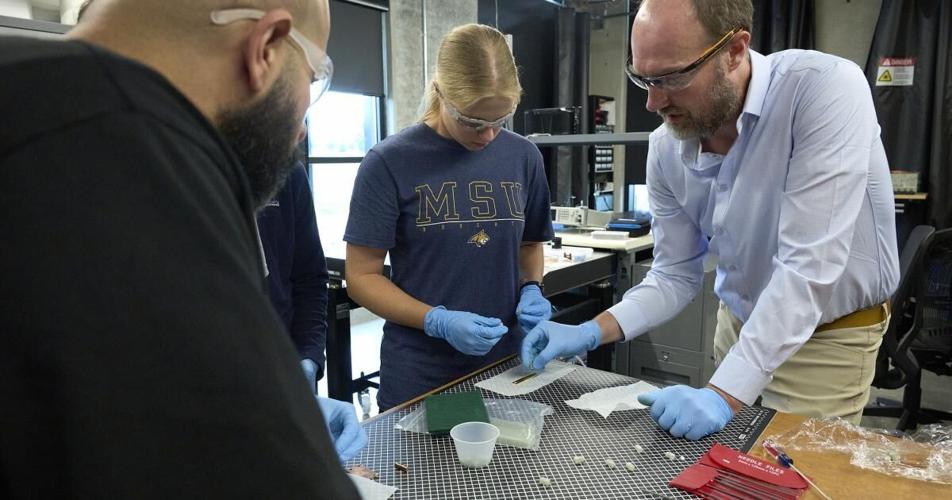
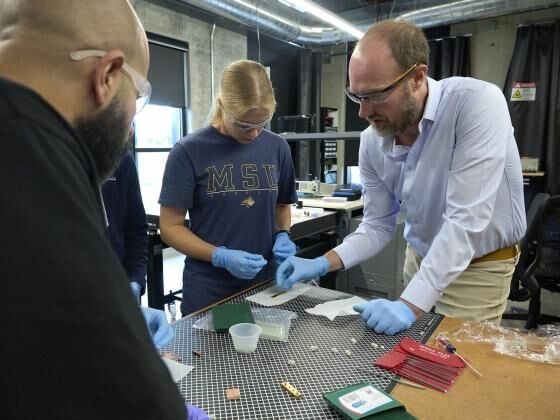
The Gallatin Valley has a long history of work with optically active crystals for lasers and classical and quantum information processing, said Tom Rust, director of QCORE’s Quantum Cryogenic Laboratory. On the second day of the camp, he worked alongside students in the lab as they learned and tested methods for mounting crystal samples in a closed-cycle vacuum cryostat. The system relies on mechanical thermal contact between the sample and the cryostat’s cold plate to conductively cool samples to temperatures near absolute zero.
At room temperature on the lab bench, students mounted samples onto gold-plated, ultra-pure copper fixtures, which then were bolted onto the cryostat cold plate and cooled. Students also installed special temperature sensors to monitor the cooldown characteristics associated with the various mounting methods. The purpose of the exercise was to determine the most effective mounting method and use it to properly cool a rare-earth-ion-doped crystal for optical experiments planned later in the course. Cooling the crystals isolates optical systems of interest sufficiently to observe and exploit their quantum behaviors, Rust explained.
Stebbins, who began working as a student researcher at QCORE last year, said he found the crystal-mounting activity particularly relevant because of his interest in materials science and mechanical interfaces.
“What we’re looking at today is how to thermally bolt different parts together and which materials would be better or worse,” he said after finishing the electroplating process that added a thin layer of gold onto the copper plate that would be used as a mounting fixture. Gold plating provides a ductile, non-oxidizing layer to improve mechanical contact and heat conduction from the crystal.
Stebbins said he hopes to pursue a research career in cryogenics, materials science and quantum computing.
“Obviously, learning and working here is as good as you can get,” he said.
Gallatin College MSU provided scholarships for both its student participants, said Mark Craig, director of the college’s advanced technology division, which offers several advanced technology and technical workforce degrees designed for rapid entry into high-demand industries.
“The cryogenics cold camp serves as an excellent opportunity for Gallatin College students to gain important exposure to key photonics-adjacent technologies and related employment opportunities within and outside the Montana region,” he said.
Five additional, private scholarships were funded by Quantum Strategix and Boston Cryogenics. MSU alumnus Luke Mauritsen is the founder and CEO of Quantum Strategix and co-founder of Boston Cryogenics. He also founded Montana Instruments.
“We are thrilled to be part of building this ecosystem and seeing what QCORE is developing, including the cryogenics boot camp,” Mauritsen said. “It is providing critical training for students who are joining the quantum industry here in Montana and the U.S.”
QCORE led the inaugural boot camp in collaboration with Honeywell Aerospace Advanced Cryogenic Platforms and Gallatin College MSU, bringing together industry expertise and academic instruction to deliver an immersive training experience. Advanced Cryogenic Platforms engineers played a key role in developing the in-depth curriculum and 170-page course textbook and served as two of the course instructors alongside Rust, bringing industry expertise and QCORE’s technical leadership to the classroom.


