


BOZEMAN — It was never a question that Mya Cluff would make her career in the arts — it was simply her family’s normal.
As an infant, she remembered often peering through a baby gate to watch her mother throwing pottery on their sun porch in Dallas, Oregon. When she was older, Cluff and her sister were paid 10 cents to scrape clay from pieces of their mother’s pottery wheel, and they spent time on college campuses where their parents taught art.
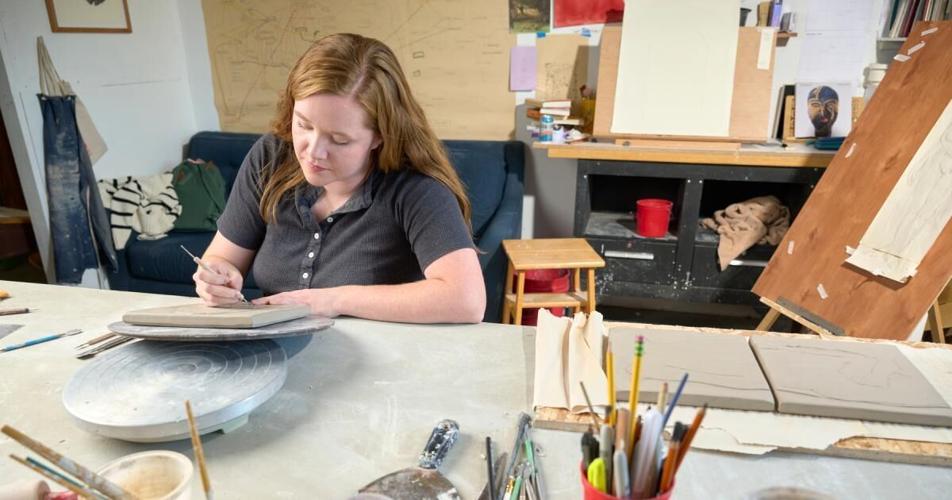
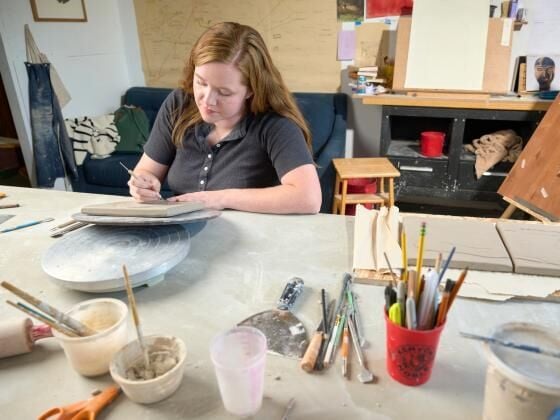
Now, Cluff’s three children ages 11, 7 and 3 are raised much the same way, sitting on her lap or lying on her blue couch as she sculpts feminine figures from clay in Montana State University’s Melvin Graduate Art Studios.
“My professional and my maternal life have always been intertwined,” said Cluff, 32, a second-year student in the Master of Fine Arts program who has lived in Montana since 2017.
People are also reading…
Her work focuses on the maternal experience, from feelings of empowerment to the heightened awareness of one’s own mortality that she says comes with raising children.
This “laser focus” on maternal art began when Cluff was pregnant with her first child as an undergraduate student at the Oregon College of Art and Craft. She researched artists who were making work about motherhood and explored how she could contribute to the conversation during a shifting point in her life. At first, she avoided sentimentality to dissuade people from calling her work “mom art.”
“I was the most scared to illustrate in my work any kind of sentimentality, kind of being afraid of having people call my work ‘cute’ or even ‘beautiful,’” she said. “Like OK, but I want you to take it seriously.”
As a working artist after college, Cluff found there was room for emotion her pieces, such as the sculpture “Home Body.” A woman’s red clay body is covered in cartoonish images of houses drawn by her daughter, and the piece was acquired by the Montana Museum of Art and Culture as commentary on a woman’s body being associated with feelings of home.
So, too, did Cluff’s children inspire “Vessel,” a work she created at MSU that explores transition and passage. Like a boat, a woman shaped from clay that is glazed black and washed in cobalt floats in a reclined position with her eyes closed and carrying three pelvises — representing Cluff’s three children — on a metaphorical journey.
Cluff fired the clay at 2,088 degrees Fahrenheit, then glaze-fired the piece at 1,945 degrees Fahrenheit, to prevent it from cracking as it hardened in the kiln, a low-temperature process she discovered with financial assistance from the College of Arts and Architecture. She attended an online workshop in January to master the process, testing glazes and materials that fire best at that temperature in the graduate studios’ electric kilns.
MSU has supported her in other ways, as well. During her first year in the program, Cluff said, the university allowed her to work shifts at the School of Art’s front desk rather than monitor undergraduate studios in the evening as typically required, meaning she could spend time with her children at night.
“That kind of flexibility was literally make or break,” Cluff said. “If they had been inflexible, I would not be here.”
When Cluff entered the Melvin Graduate Art Studios as a first-year student, she felt exposed by having her work subject to the opinions of students and faculty across mediums, but it was one of many reasons she decided to pursue a master’s degree eight years after receiving her bachelor’s. She wanted feedback from people who were committed to her success and could provide insight into how gallery goers might view her work if they weren’t mothers — Cluff was the only master’s art student with children last year.
“It was really beneficial to come into a group of people and not have them inherently understand what I was doing, like having to explain myself and say, ‘This is what I am doing and why I'm doing it and why it's important,’” Cluff said.
She said earning a master’s degree was also a way to take her next step professionally, opening doors for future teaching opportunities and eligibility for certain grants, workshops and galleries.
Cluff has displayed her work more than 41 times in galleries and museums, from Montana to New York to Ireland, including her most recent solo show in Oregon this summer. Her next solo show opens Nov. 13 in Bozeman at the Echo Arts gallery.
Bruna Massadas, Cluff’s adviser and an assistant teaching professor who contemplates the maternal experience in her own paintings, said Cluff’s work stands out among her class because she came to MSU with a strong sense of who she is, formed from years of life experiences outside school. Massadas also admires Cluff’s newfound ability to play with scale and different materials since she first arrived, such as expanding into printmaking and drawing.
Cluff and her adviser first met years ago when Massadas took Cluff's ceramics course at the Emerson Center for the Arts and Culture. Massadas said she admired the care Cluff put into helping her students develop their individuality as artists.
“She's just a light in the community,” she said.
Cluff also mentors undergraduate art students taking her comprehensive studio class, where they learn the fundamentals of shape, color and texture. Master’s students are required to teach for four semesters.
Lane Dillman, a first-year transfer student studying studio arts, said Cluff’s classroom is a safe space to explore art in a college environment for the first time. Dillman hopes to one day enroll in the Master of Fine Arts program at MSU and continue learning about art while teaching, and she recently spent an hour after class with Cluff to discuss her student experience.


