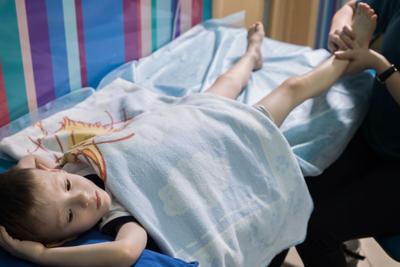


Photo provided by DepositPhotos
Between 23% and 46% of children with cerebral palsy experience clinically significant sleep problems, according to research published in the International Journal of Medical and Pharmaceutical Research. The disturbances aren't limited to short sleep duration. They include specific clinical patterns like trouble initiating sleep, excessive daytime sleepiness, and sleep-disordered breathing. Related research has tied those disturbances to poor sleep quality in caregivers, pointing to a household-level health pattern that mainstream coverage has largely missed.
The findings have circulated in clinical research for years. Mainstream coverage is only beginning to catch up.
Sleep Initiation and Daytime Sleepiness Lead the Data
People are also reading…
The same study breaks the disturbances into specific patterns. Difficulty initiating and maintaining sleep affected 30.2% of children evaluated. Wake transition disorders and excessive daytime sleepiness each affected 27.9%. Sleep-disordered breathing showed up in 16.3% of cases.
Children with more severe motor involvement carried the heaviest burden. Those classified as GMFCS Grade 5, the most severe category of motor impairment, posted the highest disturbance scores across nearly every domain. Spastic quadriplegia and extrapyramidal cerebral palsy were also strongly associated with worse sleep outcomes.
A separate study on sleep characteristics in youth with cerebral palsy found that approximately 45% of youth with CP report sleep problems compared to 25% of neurotypical youth. The CDC reports that roughly a quarter to half of U.S. children ages 4 months to 14 years get insufficient sleep on a typical night, but that figure measures sleep duration, not clinical sleep pathology. That distinction matters. Children with cerebral palsy aren't simply staying up too late. They're experiencing measurable disturbances in how sleep functions.
Researchers Point to Medical Mechanisms Behind the Numbers
The drivers aren't mysterious. Spasticity can make repositioning painful. Gastrointestinal complications, common in children with cerebral palsy, contribute to nighttime discomfort. Respiratory issues can interrupt breathing during sleep. Seizure activity, when present, often clusters at night.
Work cited by the National Heart, Lung, and Blood Institute has linked untreated sleep-disordered breathing in children to longer-term concerns ranging from cardiovascular strain to cognitive effects. For children with cerebral palsy, those risks layer on top of existing medical complexity, which is why pediatric specialists increasingly consider sleep one of the factors that influence long-term outcomes in cerebral palsy.
Caregiver Data Shows Parents Are Losing Sleep Too
When a child wakes multiple times a night, so does a parent. Research published in the International Journal of Academic Medicine and Pharmacy found that 32.86% of caregivers of children with cerebral palsy had poor sleep quality, with their sleep scores significantly associated with their child's sleep disturbance scores across multiple domains.
Broader caregiver data tells the same story. The Family Caregiver Alliance reports that family caregivers consistently struggle with sleep loss tied to nighttime caregiving demands. Sleep researchers have flagged chronic sleep deprivation as one of the mechanisms linked to depression, weakened immune response, and reduced workforce participation in long-term caregivers.
The signal is consistent across data sources. Caregiver sleep loss is functioning as a public health issue, not an individual one.
Clinical Guidance Points to Sleep Evaluation
The American Academy of Sleep Medicine recommends formal sleep evaluation for children with neurological conditions when sleep concerns are present. That can mean a referral to a pediatric sleep specialist, an in-lab polysomnography study, or a home assessment depending on the case. Positioning equipment, seizure management, GI treatment, and respiratory support can all reduce nighttime disruption once the underlying cause is identified.
Care coordination remains a barrier. Families managing cerebral palsy often juggle neurology, physical therapy, occupational therapy, and gastroenterology appointments before sleep enters the conversation. Centralized resources like the Cerebral Palsy Center exist to help parents work through medical questions, therapy options, and care planning in one place.
Access remains uneven. Pediatric sleep medicine availability varies sharply by region, and insurance coverage for sleep studies in children with disabilities isn't uniform.
The Findings Reframe a Familiar Health Topic
Sleep is one of the most-covered health topics in mainstream media, but coverage tends to orbit the same beats: screen time, melatonin, workplace fatigue. The cerebral palsy data widens that lens to include a population that has been absorbing the heaviest sleep losses for years.
It also shifts how caregiving gets framed. The cultural image of a sleep-deprived parent usually fades after infancy. For families managing cerebral palsy, the nighttime work doesn't taper. It evolves. The health data on parents reflects that.
Sleep deprivation in cerebral palsy households is measurable, documented, and largely missing from mainstream health coverage. The research has been there. Reporting is starting to catch up.