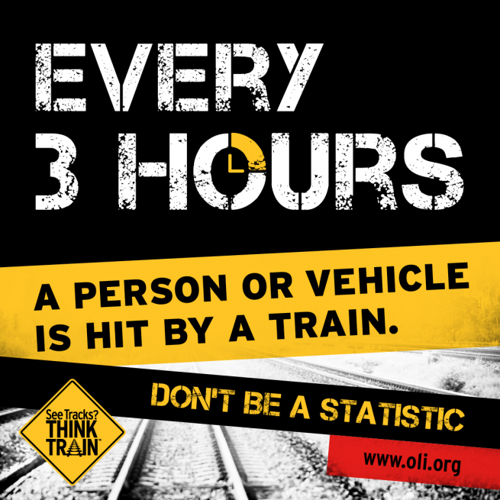


Stay off, stay away and stay alive. Better to be late than never arrive. Stick with the designated crossings so you can go home to your loved ones. And never, ever try to beat the train.
These simple phrases from Montana’s Operation Lifesaver consumer awareness campaign strike at the root cause of railway safety: drivers and pedestrians pressed for time while traveling, thinking nothing will happen to them just that one time.
Considering an average locomotive can weigh anywhere from 400,000 pounds to 200 tons, the weight ratio of a car to a train is that of a soda can to a car. And, the fact that a freight train traveling at 55 mph requires more than a mile — the length of 18 football fields — to stop, should be cause enough for a driver to hit the brakes at a flashing gate and mind the safety protocols.
Through the multiagency efforts of Operation Lifesaver — Montana state and government agencies, and highway safety organizations — program coordinators take a multipronged approach to educating drivers and pedestrians in the lessons of railway safety, including the three E’s: engineering, education and law enforcement. MTOL is part of the nationally recognized nonprofit organization and leader of rail safety education, Operation Lifesaver Inc., which was founded in 1972.

“Unfortunately, every year people in Montana are killed or injured at highway-rail crossings, as well as along other locations on the tracks,” said John Althof, president of MOTL. “With deer season and the holidays approaching, there are even more reasons to stay alert and mindful.”
Ignoring warning signs and signals, maneuvering around lowered gates, stopping on the tracks, or simply not paying attention all lead to injuries and fatalities. Althof said people also make the mistake of using the tracks as a shortcut or for recreational use when walking or running when, in fact, it is illegal to be on them as it is considered private property. As trains often extend three feet or more beyond the rail on either side, the safety zone for pedestrians is well beyond what one would initially think. Even when a track looks unused, assume it is in use.
Althof said another misconception is that trains are loud and people can easily hear them. However, thanks to technology and track engineering, trains today are quieter and faster, can run on any track, at any time, from either way, and not on any schedule.
“The days of the telltale ‘clackety-clack’ is no longer an indicator that a train is approaching. So, always expect a train,” Althof said. “Another ‘always’ to adhere to: Look in both directions when at a crossing. Cross quickly and don’t stop.”
It’s also important to refrain from texting or using any devices like headphones or earbuds, which can prevent an individual from seeing or hearing an approaching train.
In addition to speaking to school groups, driver ed classes, community audiences and emergency responders, MTOL has recently begun using geofencing software in highly trafficked areas and near event venues. The software sends text and Facebook railway safety reminders to drivers and pedestrians within these designated areas.
“Trains and cars just don’t mix. Ever,” Althof said. “These are simple messages that will allow Montana drivers and pedestrians to look, listen and live.”
For more information, please visit community.oli.org/state/mt#about.